
BitReal · London
Building the UK's first platform at the intersection of income-producing real estate, Bitcoin treasury accumulation, and automated financial infrastructure.
The Thames at low tide · London, March 2025
The next generation of property companies will not just own buildings. They will own Bitcoin. A new financial architecture is emerging — one that will reshape how property is owned, financed and operated.
For centuries the global financial system has relied on physical collateral — land, buildings and other tangible assets that banks lend against. But over the next decade that system will expand to include a second form of collateral: digitally scarce assets. Bitcoin has introduced the first truly global form of scarce digital property — a form of collateral that can move instantly across financial systems. At the same time, artificial intelligence is transforming how financial information is processed and how capital is allocated. And the world's largest asset class — real estate — is entering a period of structural reset. The convergence of these three forces will reshape how property is owned, financed and operated.
Global real estate is estimated to be worth more than $300 trillion, making it the largest store of wealth in the world. It underpins global lending markets, pension systems and sovereign balance sheets. But its significance extends beyond capital values. Globally, income-producing real estate generates an estimated $3.5 to $4 trillion in annual rental income. In the UK alone, the combined residential and commercial property market produces approximately £250 to £300 billion in rental revenues each year. This is not a static asset class. It is a vast, continuously operating income engine.
Yet despite its scale, the property industry still operates on infrastructure built for a previous era. Transactions routinely take months. Financial data moves through PDFs and spreadsheets. Legal documentation is fragmented across multiple intermediaries. A single acquisition can involve thousands of pages of documentation and dozens of participants. Compared with modern financial markets, real estate remains one of the least technologically transformed sectors of the global economy. That will change. Over the next decade the real estate industry will be rebuilt on new technological foundations.
Bitcoin represents the first globally verifiable form of scarce digital property. Its supply is permanently capped at 21 million coins. Ownership can be verified instantly on a public ledger. It trades globally twenty-four hours a day and can be transferred across borders within minutes. For the first time in human history monetary scarcity exists in digital form.
These characteristics make Bitcoin uniquely suited to become pristine collateral within the emerging digital financial system. Collateral that can be verified instantly. Collateral that can move globally. Collateral that can be liquidated in minutes rather than months.
Over the coming decade Bitcoin will become a foundational collateral asset within global finance. Institutions will increasingly hold Bitcoin on their balance sheets. Credit markets will evolve around Bitcoin-backed lending. Digital collateral will sit alongside traditional assets such as real estate in the structure of modern financial markets.
Bitcoin has also been the best-performing major asset of the modern era. Over long periods its compound annual growth rate has materially exceeded that of equities, bonds and real estate. Even if future returns are significantly lower than historical levels, Bitcoin remains one of the most asymmetric monetary assets ever introduced into global markets.
Artificial intelligence is transforming how financial decisions are made — and property is one of the most underautomated industries in the world. Acquisition underwriting, mortgage origination, tenancy management, rent review, compliance monitoring and asset disposal all remain largely manual, paper-based and slow. This friction is a cost. And cost is yield.
BitReal applies artificial intelligence across its investment process — from deal analysis and underwriting to ongoing portfolio management. AI reduces the time and cost required to identify, acquire and operate assets, compressing processes that traditionally take weeks into hours. Lower operating costs mean higher net yield. Higher net yield means more surplus cash flow available for Bitcoin accumulation. The property platforms that operate more efficiently will compound faster than those that do not.
Real estate and Bitcoin possess complementary characteristics. Real estate generates predictable cashflow. Bitcoin preserves monetary scarcity. When combined strategically they create a powerful financial flywheel.
The process begins with the acquisition of income-producing real estate assets. During periods of market repricing these assets can often be acquired at attractive valuations. Once stabilised and producing reliable rental income, the assets can be refinanced using long-term debt structures. This refinancing unlocks capital while ownership of the underlying property is retained.
The released capital is then deployed in two directions: into additional real estate assets, expanding the income-producing portfolio; and into Bitcoin as a treasury asset. At the same time, rental income from the properties continues to generate cashflow that can be systematically allocated — a portion reinvested into further Bitcoin accumulation, the remainder deployed into additional acquisitions or returned to the balance sheet. UK residential property currently yields between 4 and 6%, with commercial assets generating 5 to 8%. Even a modest allocation of that recurring income into a Bitcoin treasury — reinvested consistently over time — compounds into a meaningful monetary reserve.
Over time this creates a compounding balance sheet anchored by two forms of collateral — physical collateral in income-producing real estate, and digital collateral in Bitcoin. Real estate powers the system with predictable income. Bitcoin strengthens the balance sheet with digitally scarce monetary collateral. As the Bitcoin treasury grows, it will support new forms of borrowing without requiring the underlying Bitcoin to be sold. Artificial intelligence accelerates every stage of this cycle — reducing the time and cost of acquisition, underwriting and portfolio management, and ensuring more of the income generated reaches the Bitcoin treasury rather than being consumed by operational overhead.
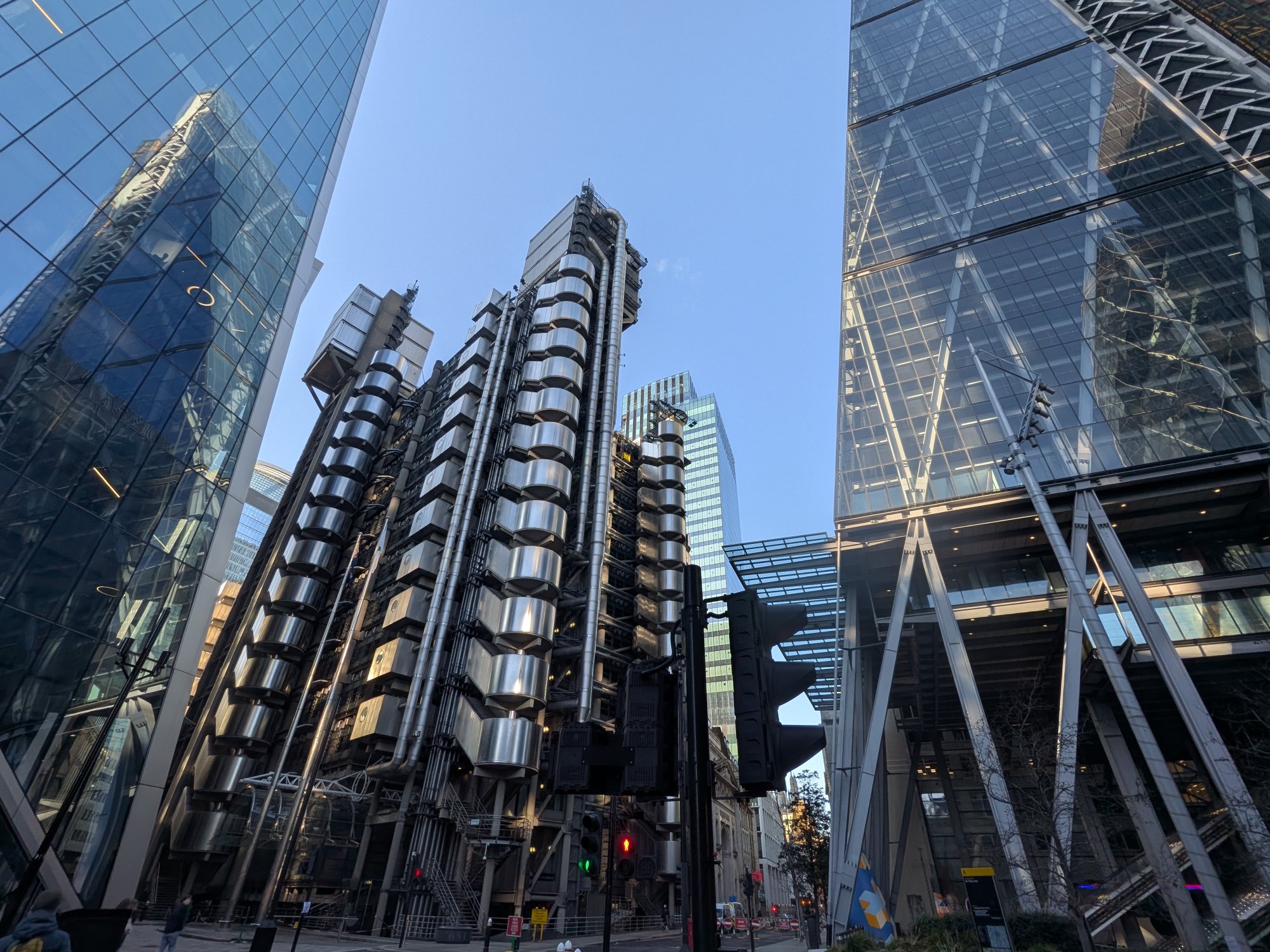
London remains one of the most important financial centres in the world. The UK financial services sector contributes over £280 billion annually to the economy, representing roughly 12% of national GDP, and employs more than 2.5 million people. London also hosts one of the fastest-growing artificial intelligence ecosystems in Europe, with more than 3,000 AI companies operating across the UK and billions of pounds flowing into the sector each year.
At the same time the city anchors one of the deepest and most internationally owned real estate markets in the world, attracting capital from every continent. London will not become another Silicon Valley. Its advantage is that it does not need to. Where Silicon Valley optimised for venture capital and startup formation, London sits at the intersection of technology, finance and global markets. Builders, investors and technologists operate inside the same financial ecosystem that moves trillions of dollars of capital every year.
Periods of market pessimism and repricing often create the greatest opportunities for long-term builders. And London is entering precisely such a moment. Importantly, this mechanism is not restricted to London — the underlying model is geographically transferable. Wherever real estate generates stable income and financial data can be sourced directly from origin systems, the same structure can be applied.
Despite London being one of the largest and most sophisticated real estate markets in the world, the sector remains almost entirely disconnected from the emergence of Bitcoin. Most property investors still operate within frameworks designed for the financial system of the past — focused on rental yields, leverage ratios and interest rate cycles. Bitcoin is often viewed as speculative or irrelevant to property investment. This perspective is increasingly outdated.
Over the past decade Bitcoin has evolved from a niche digital experiment into a global monetary asset held by institutions, public companies and sovereign investors. At the same time the London property market is experiencing structural pressure. Higher interest rates have reduced leverage. Tax policy has squeezed smaller landlords. Transaction volumes have slowed. Many traditional property investors are now focused on defensive positioning rather than innovation.
But environments like this create opportunity. The combination of income-producing real estate and Bitcoin treasury accumulation remains one of the most underexplored strategies in the London market today. London possesses all the ingredients required to lead this shift — yet the bridge between property capital and Bitcoin balance sheets has barely been built. That gap is where the opportunity lies.

Within the BitReal model, the capital structure is anchored by three complementary layers:
| Layer | Role | Characteristics |
|---|---|---|
| Real Estate | Income engine | Predictable rental cashflow and physical collateral |
| Bitcoin Treasury | Monetary reserve | Digitally scarce asset with global liquidity |
| AI Infrastructure | Efficiency layer | Reduces underwriting, acquisition and operating costs |
Real estate provides the cash-generating base. Rental income supports operating costs and debt servicing while creating the potential for stable distributions. Bitcoin functions as a monetary reserve asset — rather than being sold, accumulated Bitcoin can increasingly serve as collateral within emerging global digital credit markets. Artificial intelligence reduces the cost of analysing assets, underwriting transactions and managing property portfolios at scale.
Together these elements create a structure designed to combine predictable income, long-term monetary appreciation, and increasing operational efficiency within a single balance sheet.
Global real estate exceeds $300 trillion in value and generates trillions of dollars in annual income. Bitcoin has a permanently fixed supply of 21 million coins and a market capitalisation that remains small relative to global financial assets. As institutions and sovereign capital accumulate Bitcoin, digitally scarce collateral will rise in importance within the global financial system.
Few strategies combine predictable income with exposure to a globally scarce monetary asset. A portfolio of income-producing property combined with a growing Bitcoin treasury compounds in two directions simultaneously — income growth through real estate operations, and monetary appreciation through Bitcoin scarcity. As Bitcoin increasingly functions as collateral within financial markets, holders of large Bitcoin treasuries will gain access to new forms of borrowing and liquidity without selling their underlying assets.
Major financial transitions often appear gradual — until they accelerate suddenly. Over the next decade three powerful adoption curves will reinforce one another. Artificial intelligence will rapidly reduce the cost of analysing financial data and operating large asset portfolios. Bitcoin will continue to mature as a global monetary asset and collateral base. And real estate markets will increasingly seek new sources of liquidity and capital efficiency.
Once institutional investors begin to recognise the strategic advantage of combining income-producing real estate with Bitcoin treasury accumulation, the model will spread quickly. Capital flows toward structures that compound more efficiently. The property platforms that integrate these systems early will build structural advantages that are difficult for traditional operators to replicate. What begins as an unconventional strategy will become a new financial standard.
BitReal is positioned to capture this convergence. The strategy is simple. Acquire and operate high-quality income-producing real estate. Use refinancing and rental income to accumulate Bitcoin as a long-term treasury asset. Apply artificial intelligence to reduce friction, lower operating costs and increase efficiency across the portfolio.
Property provides the income. Bitcoin provides the balance sheet strength. Artificial intelligence provides the operating system. This structure does not yet exist at scale in the UK market. BitReal is the first platform in the UK built specifically at this intersection.
Three global transformations are now underway simultaneously: artificial intelligence, digital monetary networks, and global real estate repricing. Over the next decade these systems will converge. Property markets will become technologically driven. Bitcoin will become foundational collateral. Artificial intelligence will become the operating system of capital.
The future of property will not simply be built with bricks and steel. It will be built with capital, code and cryptography. And the companies that recognise this shift early will define the next era of real estate.

City of London skyline · March 2025
About
Our team combines decades of property investing, development, financing and mortgage expertise with deep regulatory knowledge and cutting-edge technology — positioning us to build the next generation of real estate infrastructure at the intersection of physical assets, digital money and artificial intelligence.
Contact
Thank you — we'll be in touch shortly.
Prefer to reach us directly?
Disclaimer. This website is intended for information purposes only. Nothing on this site constitutes financial, legal or investment advice, nor does it constitute a financial promotion under the Financial Services and Markets Act 2000. BitReal is not authorised or regulated by the Financial Conduct Authority.